Best bee suit
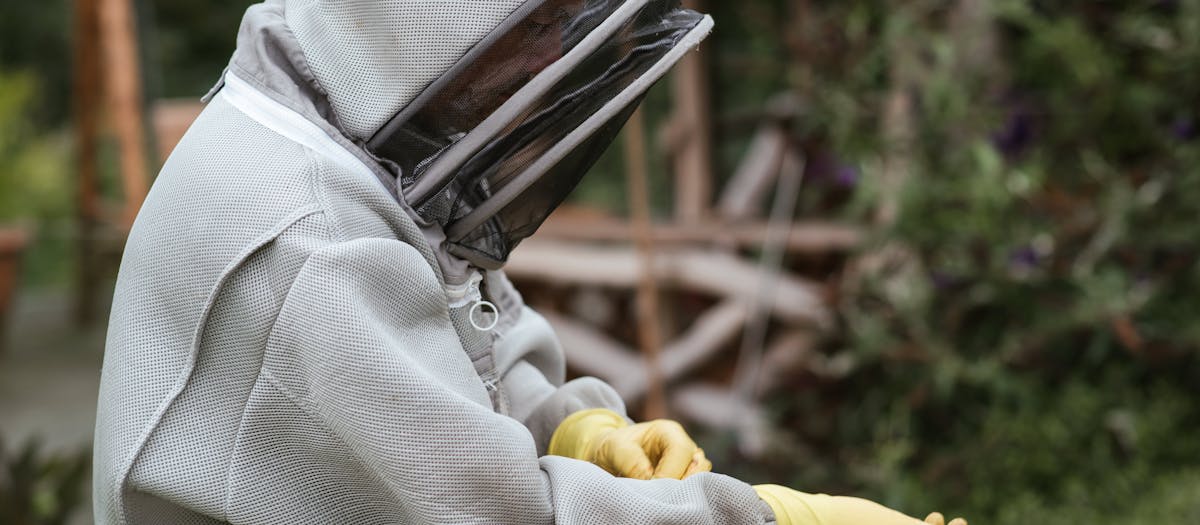
A good bee suit does more than keep stings off. It lets you work slowly and calmly in the hive, and calm, unhurried hands keep the colony calm too — so the right suit actually makes your bees gentler. This guide explains the five specs that decide whether a suit suits you — type, ventilation, veil style, material and sizing — then points you to the picks once they are verified.
A note on how to read this. There is no single best suit for everyone, because the right one depends on your climate, your budget, and how covered you want to feel. So the value here is the framework — what each spec changes — so you can shortlist a suit that fits your situation, then compare the options. Read the framework first, then look at the picks.
How to choose a bee suit
Five things decide whether a suit suits you. Run any suit through these — they are exactly the columns in the comparison below.
Type — full suit versus jacket
The first choice is how much of you is covered. A full suit runs head to ankle and is the most reassuring option for a beginner; a jacket covers the upper body and veil, leaving your legs in your own trousers, and is cooler and quicker for a short check. For a first year I steer people to a full suit, then a jacket later once confidence grows. The gear hub walks through this choice in more depth.
Ventilation — three-layer mesh versus none
A ventilated suit uses a three-layer mesh that bees cannot reach skin through and that breathes far better, which transforms working hives in summer heat. The trade-off is cost — ventilated suits are noticeably pricier. Non-ventilated cotton is warmer but cheaper. If your summers are hot and humid, ventilation earns its price; if your climate is mild, you may not need it.
Veil style — fencing versus round
The veil guards your face and neck. A fencing-style veil zips to the suit, gives good visibility, and is easy on and off — the common modern choice and a good beginner default. A round veil on a hat brim keeps the mesh further from your face but can feel bulkier. Make sure whichever you pick seals completely to the suit, with no gaps at the zip.
Material — cotton, poly-cotton or synthetic mesh
Material decides durability, warmth and washability. Cotton and poly-cotton are the traditional, affordable choice — sturdy and easy to wash, but warm. Synthetic three-layer mesh is lighter and cooler but costs more and can be bulkier to store. For a first suit, a sturdy poly-cotton or a mesh suit both serve well; pick for your climate.
Sizing — fit decides protection
Sizing is not a detail; it is what makes the suit work. Too tight and fabric pulls against skin where a bee can sting through; too loose and you snag and fumble. Measure yourself against the manufacturer's chart rather than guessing from your clothing size, and allow for the layers you will wear underneath. A suit that fits is a suit you will trust.
The suits compared
A short list of widely available suits and jackets, compared on the five specs above. Specs are verified against manufacturer details and current Amazon listings — no hands-on testing claims, just the figures and the trade-offs that decide the fit.
| Best for | Type | Ventilation | Veil style | Material | Sizing |
|---|---|---|---|---|---|
| Best overall | Full suit | Ventilated mesh panels — 280 gsm polycotton body with synthetic mesh ventilation zones | Fencing veil (collapsible, removable) | 50% cotton / 50% synthetic blend with ventilation mesh panels | XXS–6XL (unisex) |
| Best budget | Full suit | Breathable cotton weave (standard, non-mesh) | Fencing veil (detachable, metallic mesh hood) | 100% cotton | S–XXL (unisex) |
| Best ventilated | Full suit | 3-layer ventilated mesh — 6 mm air gap prevents stingers reaching skin | Round hood (detachable; roomy design keeps veil off face) | 3-layer polyester ventilated mesh; YKK brass zippers; made in USA | X-Small–XX-Large |
| Best jacket | Jacket / half-suit (no trousers) | 3-layer mesh ventilated construction | Round accordion veil (zips to collar, self-supporting) | 3-layer cotton/polyester mesh blend | S–2XL (unisex) |
| Best for kids | Full suit (children's / youth) | Ventilated lightweight cotton construction | Self-supporting round veil hood (detachable, flame-resistant mesh) | Lightweight 100% cotton | Fits 4'2"–4'7" (multiple size variants cover 3'6" to 4'11") |
Our top picks
Best overall: Humble Bee 431 Ventilated Beekeeping Suit With Fencing Veil

Best overall
Humble Bee 431 Ventilated Beekeeping Suit With Fencing Veil
Humble Bee
- Type: Full suit
- Ventilation: Ventilated mesh panels — 280 gsm polycotton body with synthetic mesh ventilation zones
- Veil style: Fencing veil (collapsible, removable)
- Material: 50% cotton / 50% synthetic blend with ventilation mesh panels
- Sizing: XXS–6XL (unisex)
- Best for: Hobbyist and backyard beekeepers wanting durable ventilated protection across a wide size range
The Humble Bee 431 is a top-selling ventilated full suit built from a durable polycotton blend with breathable mesh panels to keep you cool in warm weather. Brass zippers, cushioned kneepads, double-stitched pockets, and a canvas carry case make it a well-rounded everyday suit.
Last checked 2026-05-21
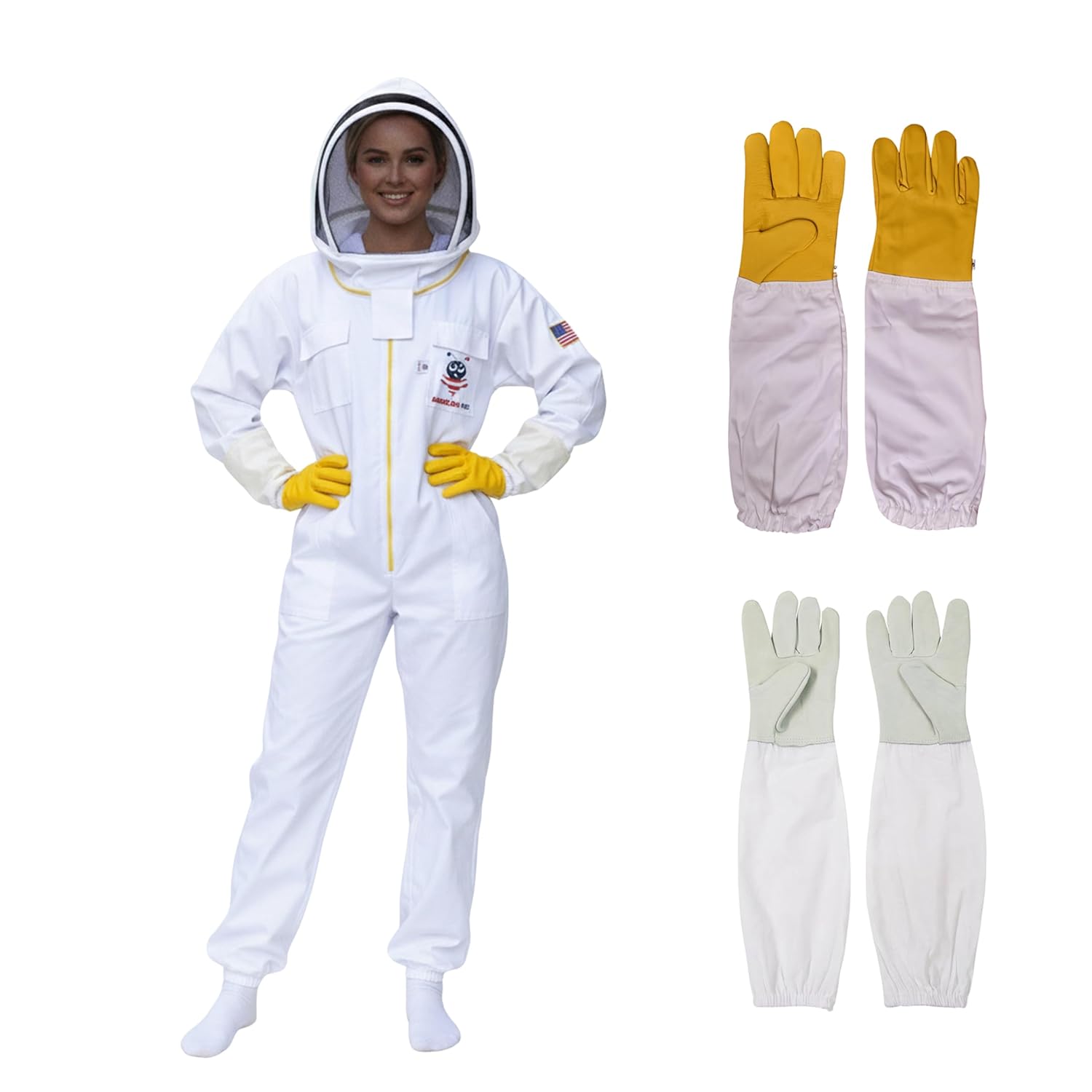
Best budget: Cotton Beekeeping Suit, Full Body Beekeepers Protective Gear with Fencing Veil Hood, Elastic Cuffs & Breathable Fabric, With Two Pairs of Gloves
Best budget
Cotton Beekeeping Suit, Full Body Beekeepers Protective Gear with Fencing Veil Hood, Elastic Cuffs & Breathable Fabric, With Two Pairs of Gloves
American Bee
- Type: Full suit
- Ventilation: Breathable cotton weave (standard, non-mesh)
- Veil style: Fencing veil (detachable, metallic mesh hood)
- Material: 100% cotton
- Sizing: S–XXL (unisex)
- Best for: Budget beginners; value pick — includes 2 pairs of gloves
A budget-friendly full cotton bee suit that ships with two pairs of gloves and a detachable fencing veil with industrial-grade metallic mesh. Elastic cuffs, Velcro ankle closures, and leg-high zippers make it straightforward to put on without disturbing footwear.
Last checked 2026-05-21
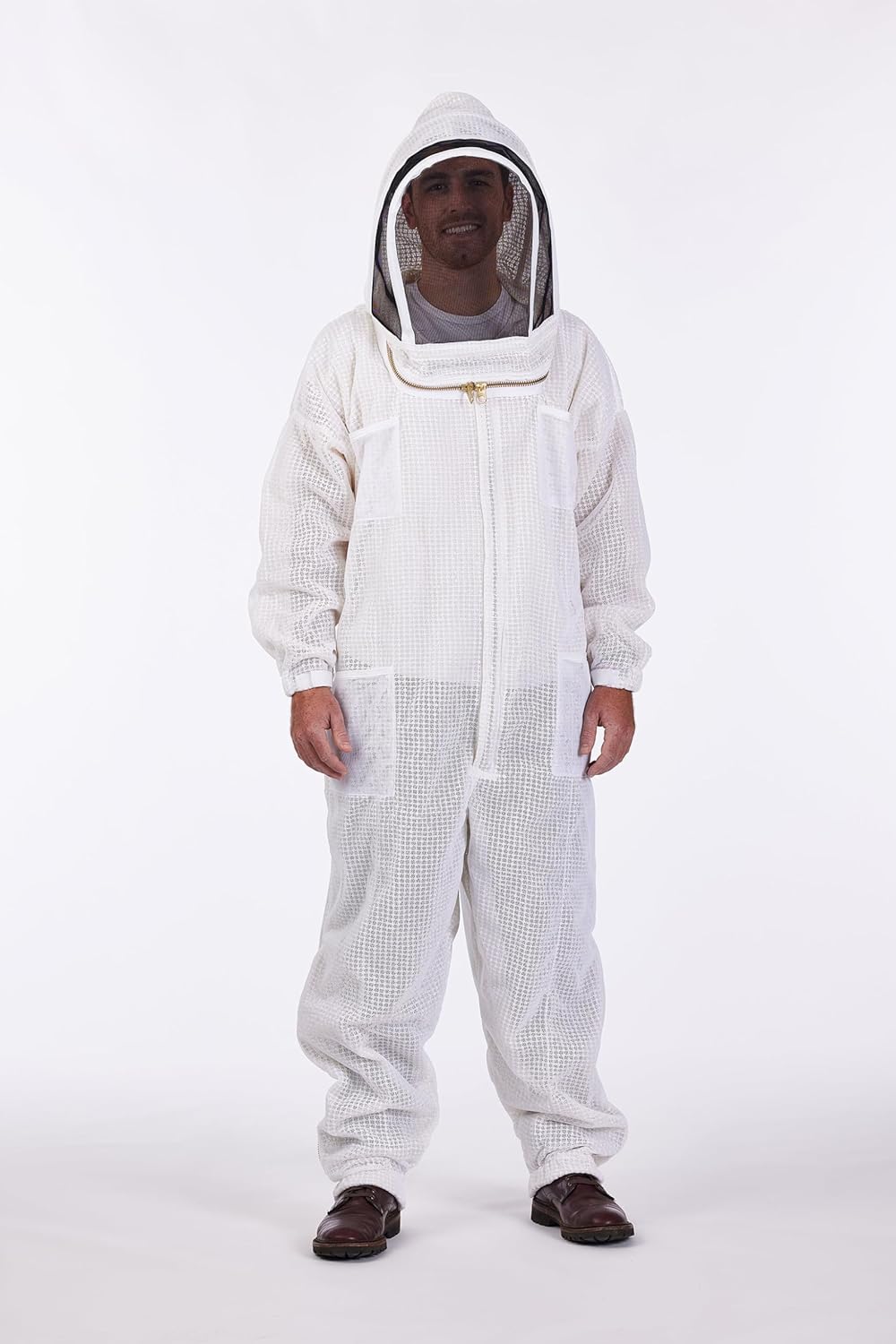
Best ventilated: Ultra Breeze Beekeeping Suit With Hood, 1 Unit, White, Large
Best ventilated
Ultra Breeze Beekeeping Suit With Hood, 1 Unit, White, Large
Ultra Breeze
- Type: Full suit
- Ventilation: 3-layer ventilated mesh — 6 mm air gap prevents stingers reaching skin
- Veil style: Round hood (detachable; roomy design keeps veil off face)
- Material: 3-layer polyester ventilated mesh; YKK brass zippers; made in USA
- Sizing: X-Small–XX-Large
- Best for: Hot-climate beekeeping; maximum airflow with full sting-proof protection
The Ultra Breeze is the benchmark 3-layer ventilated suit in the hobby, made entirely in the USA from triple-layer mesh that keeps stingers well away from skin while maintaining exceptional airflow. Two-way YKK brass zippers and knee-high leg zips allow easy on/off over boots.
Last checked 2026-05-21
Best jacket: Rural365 Ventilated Beekeeping Jacket and Veil - Large Sized Ventilated Bee Jacket Bee Suits for Men and Women

Best jacket
Rural365 Ventilated Beekeeping Jacket and Veil - Large Sized Ventilated Bee Jacket Bee Suits for Men and Women
Rural365
- Type: Jacket / half-suit (no trousers)
- Ventilation: 3-layer mesh ventilated construction
- Veil style: Round accordion veil (zips to collar, self-supporting)
- Material: 3-layer cotton/polyester mesh blend
- Sizing: S–2XL (unisex)
- Best for: Beekeepers who already own trousers; lightweight half-suit at a budget price
The Rural365 ventilated jacket pairs a lightweight 3-layer mesh body with a self-supporting round accordion veil that zips securely at the collar. Elastic wrist cuffs, thumb straps, and an elasticated waist keep the jacket in place during active hive work.
Last checked 2026-05-21
Best for kids: Luwint Kids Beekeeping Suits - Ventilated Bee Beekeeper Suit with Gloves and Self Supporting Veil Hood for Children (White/4'2''-4'7'' Height)

Best for kids
Luwint Kids Beekeeping Suits - Ventilated Bee Beekeeper Suit with Gloves and Self Supporting Veil Hood for Children (White/4'2''-4'7'' Height)
Luwint
- Type: Full suit (children's / youth)
- Ventilation: Ventilated lightweight cotton construction
- Veil style: Self-supporting round veil hood (detachable, flame-resistant mesh)
- Material: Lightweight 100% cotton
- Sizing: Fits 4'2"–4'7" (multiple size variants cover 3'6" to 4'11")
- Best for: Children aged ~8–12 learning beekeeping alongside an adult; includes gloves
Luwint's kids bee suit offers full-body sting protection in a lightweight cotton suit purpose-built for smaller frames, with a detachable flame-resistant round veil, four pockets, elastic cuffs, and gloves included. Multiple size variants cover heights from 3'6" to 4'11".
Last checked 2026-05-21
Who should buy what
The cautious first-timer
A full suit with an attached fencing veil and gloves. Maximum coverage means minimum worry, which means calmer hands and calmer bees. This is the setup I recommend to nearly every new beekeeper for their first season.
Anyone keeping bees in heat
Pay for a ventilated three-layer suit. Working a hive in a non-ventilated suit on a humid afternoon is genuinely miserable, and discomfort makes you rush — which is exactly when you get stung. In a hot climate, ventilation is the spec to prioritise.
The confident keeper or quick checker
A jacket is lighter, cooler and faster to throw on for a short inspection. Once you trust yourself around the hive and only need upper-body cover, a ventilated jacket with a fencing veil is a practical step down from a full suit.
What to pair with your suit
Your suit is one of three first-year purchases, alongside the hive itself and the inspection tools. If you have not chosen a hive yet, start with the best beehive for beginners guide. And the tool that pairs most directly with your suit is a smoker — once you are protected and calm, a few puffs of smoke keep the colony manageable while you work. The best bee smoker guide compares them on the specs that matter.
Frequently asked questions
Do I need a full bee suit or is a jacket enough?
For a first-year beekeeper, a full suit is the more reassuring choice — when you are not worrying about a sting on the leg you work more calmly, and calm hands keep calm bees. A jacket covers the upper body and veil only, is cooler and quicker to put on, and is popular once you gain confidence. Start with a full suit; move to a jacket later if you want to.
Is a ventilated bee suit worth the extra cost?
If your summers are hot and humid, yes. A ventilated suit uses a three-layer mesh that bees cannot sting through and that breathes far better than cotton, which makes a real difference working hives in heat. If your climate is mild or your budget is tight, a cotton or poly-cotton suit protects just as well and costs much less — it is simply warmer to wear.
What veil style is best for a beginner?
A fencing-style veil attached to the suit or jacket is the straightforward beginner pick. It gives good visibility, zips on and off easily, and stays clear of your face. Round veils on a hat brim keep the mesh further from your face but can feel bulkier. Whichever you choose, the veil protects your face and neck, which is the area you least want stung.
How should a bee suit fit?
Protective gear only works if it fits properly. Too tight and the fabric pulls against your skin where a bee can sting through it; too loose and you snag on the hive and move clumsily. Check the manufacturer size chart against your own measurements rather than your usual clothing size, and remember you will wear layers underneath. Sizing is one of the specs we compare directly.
Do I need gloves with my bee suit?
Start with gloves while you build confidence — usually leather or goatskin with long gauntlets covering the forearm. They cost some dexterity, which is why many experienced keepers later switch to thin nitrile gloves or bare hands for fine work. There is no rush. Begin protected and trade protection for dexterity only when you feel ready.
Can children wear a bee suit too?
Yes — youth-sized suits exist for kids working hives with an adult. The same fit rules apply: snug enough that fabric does not pull against skin, loose enough to move freely, with a securely attached veil. Always supervise children around hives, and make sure their suit and veil seal completely before you open a colony.